In the woods, leading someone to your spot is the greatest act of trust between two mushroom hunters. It's done with a child, a forty-year-old friend, the person who taught you. It's not done with an app: and that's exactly why you can do it with MushScout.
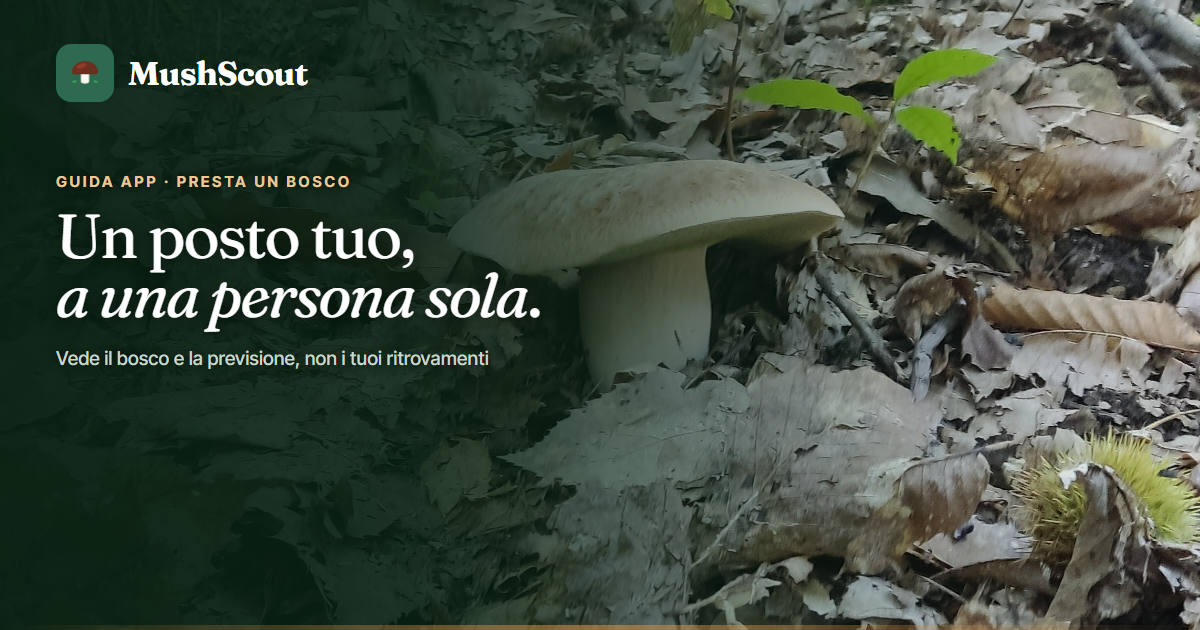
Lend this forest to a friend It's on the site's page. Whoever receives it sees the forest and its prediction, not your findings: he knows where it is and when it's best to go there, not what you've collected or how many times.
Three differences from real life
- One person at a time. It's not a group, it's not a list: it's a loan, like things that are truly lent.
- It retires whenever you want. With one touch the place becomes yours alone, and the other person can no longer see it.
- The place passes, not the diary. The prediction yes, the findings no: those remain your stuff.
It serves Premium to both of youIt's not a commercial whim: it's a feature that lives between two accounts, and the other must be able to receive it.
Because no other app can do it
To lend a place you must first have one that is yourIn apps where mushroom maps are public, or where finds end up on a shared map, there's nothing to lend: it already belongs to everyone. Here are the places nobody sees them, and that's why giving one to someone means something.
That's also why we don't call it "sharing your seats." Sharing means putting them in the middle. This is a revocable loan, between two people.
What he sees, and what he doesn't see
See the place and his forecast: where is the forest and how much is it worth, today and in the days to come, as you see it. Doesn't he see yours? findings: neither how many, nor when, nor exactly where in that forest. And he sees nothing else from your diary—the other places remain invisible as before.
It's a difference that matters more than it seems. The location is information you share once; the diary is the work of years, and that's what makes a good mushroom hunter. Lending one doesn't mean giving the other away.
When it makes sense
The classic case is the son or grandson who starts: you give them the forest at home, the one they also know, and you leave them the calendar that tells them when to go there. The second is the friend you always go with, who goes anyway when you can't. The third is the opposite: you borrow someone else's place, because you have nothing in that valley and they do.
In all three cases the loan works because it is revocableIn life, you can't take back a position you've already shown; here, you can, and knowing you can make it easier to give it.
How to do it
- Become friends in the app: everyone has a code, you send it to him on WhatsApp and he pastes it. The same code gives you both a month of Premium, once per account.
- Open the place page that you want to lend.
- Lend this forest to a friend, and choose the person.
- Whenever you want, from the same place, you can collect it.
And when you go together
If you do the tour on the same day, there is Go out with a friend: you see each other on the map in real time, up to two companions, and the location is shared only as long as the exit lastsInviting is premium; accepting an invitation is free.
Frequently Asked Questions
Does my friend see my findings?
No. He sees the place and its predictions. How many times you've been there, how much you've collected, and when, remain yours.
Can I lend it to more than one person?
No: one at a time. It's a choice, not a technical limitation—a place lent to ten people is no longer lent to anyone.
If I take it back, has he already copied the coordinates?
If he marked them himself, yes: like in life, when you take someone somewhere, they know the way. The app removes the place from its app; trust remains your choice.
Does he need Premium too?
Yes, both. The free month with the friend code also serves this purpose: we can try it together.