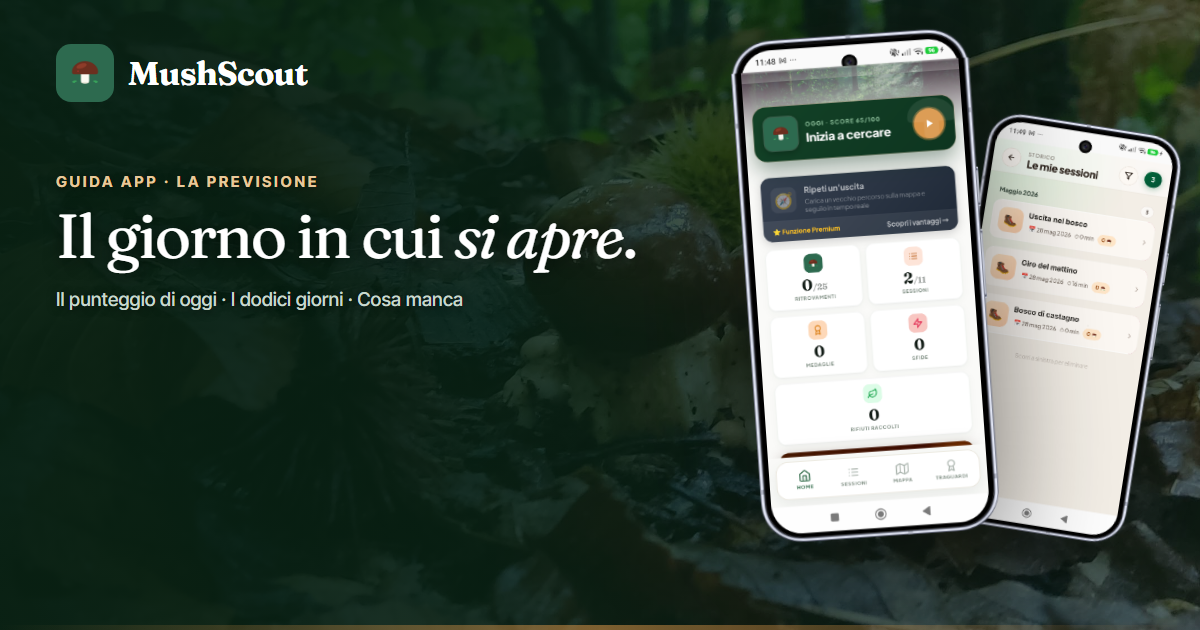
Apri l’app e trovi un numero. Da solo dice poco: 62 non è né buono né cattivo finché non sai a che bosco si riferisce, in che stagione, e che cosa sta aspettando. Qui vediamo come si legge la previsione di Mush Scout — il numero di oggi, i dodici giorni che seguono e il giorno da cui vale la pena uscire.
Today's score
Il numero grande in cima parla della giornata: è la Average dei funghi di stagione in quel bosco, non il punteggio del fungo messo meglio. Fino a poco fa era proprio quello, e misurato su 203 uscite vere dei nostri utenti azzeccava quanto una monetina; la Average, invece, separa i giorni buoni da quelli a vuoto. Per questo i numeri sono più bassi di prima. Il punteggio di un fungo preciso sta nella sua scheda, col suo nome accanto.
Non è una probabilità di successo e non promette niente: dice quanto le condizioni di oggi somigliano a quelle dei giorni in cui, in quel bosco, si è trovato davvero qualcosa.
This is why the same day can be worth 70 in your beech forest and 30 in the chestnut grove ten minutes away by car. They are two different woods, with two different stories behind them.
The twelve days, not just today
Below the score there is a row of bars: today and the eleven days to come. It is the calendar of that forest.
It helps to answer the question we really ask ourselves on Thursday evenings: Should I go on Saturday or wait until next week? If the bars go up, the window is coming. If they go down, the good moment is over and it is better to look elsewhere. Nella scheda di ogni fungo la colonna del giorno migliore ha un colore suo, e sopra c’è scritto in parole qual è: non serve confrontare le barrette a occhio.
The day it opens
Above every forest there is only one line, and it is the one that decides the day: «Porcini: opens Thursday 11th».
Be careful how you read it, because that's the point of the whole calendar. That Thursday is first day when it makes sense to go there, not the day the score is at its highest. If the window opens on Tuesday and culminates on Thursday, waiting for Thursday throws away two good days — and in those two days someone else turns over the woods.
Anyone who has been picking mushrooms for a while already knows: the first days of a trip are the best, not because there are more mushrooms, but because you are there first.
What is missing, and how much is missing · Premium
A low score without explanation is just a closed door. This is why it says under the number because it is low:
- «There is no water: 12 mm have fallen, we need another 28.»
- “It's too hot: 6 degrees above the range in which they are usually born.”
- “It's not your season here.”
Those 28 mm are not a figure of speech. They are the rain that would be needed for the score to reach the threshold: the app calculates them by asking its model. It means that prediction is possible deny: if it rains as much as he said and nothing is born, the model was wrong, and you know it first.
Il perché, con i millimetri e i gradi, è una delle cose che si vedono con Premium.
«Not yet: Thursday goes from 38 to 71»
Every now and then waiting really changes your day, and then the app writes it to you. It happens rarely, and it's intentional: usually the score moves by two points per day, and a notice that arrives every day stops being read after a week.
Each mushroom has its own calendar
I funghi seguiti sono sedici, e ognuno ha parametri suoi. Il porcino aspetta la pioggia di circa due settimane prima. Il finferlo vuole settimane umide, non un temporale. La spugnola aspetta che il terreno si scaldi in primavera.
Geography also shifts dates: the season changes with altitude and latitude, so the calendar of a mushroom farmer in Trentino is not that of one in Sicily. If you want to understand how much altitude matters, we told you about it in go up in altitude.
Per i porcini d’autunno conta anche la temperatura del suolo. Dalle uscite vere di chi usa l’app: da settembre in poi, col suolo ancora caldo, si torna a mani vuote più spesso. D’estate no, perché i porcini estivi in quota nascono proprio col suolo caldo — ed è un buon esempio di cosa vuol dire che il modello impara dalle uscite, comprese quelle andate male.
E la stessa pioggia non vale sempre uguale. Quaranta millimetri su un bosco asciutto da tre settimane e gli stessi quaranta dopo un mese piovoso non fanno la stessa cosa: sul terreno già bagnato l’acqua conta di più, e il modello ne tiene conto.
For four mushrooms growing on the wood the score does not appear, and it is a choice: the weather says nothing useful about them, and a random number is worse than no number at all.
The first few days the forecast is still immature
It's worth saying it clearly: as soon as you install the app, it knows nothing about your woods. At the beginning you see the score of the area and the season of the species, not the forecast on yours places. That is built with the exits you record — including the ones that ended empty-handed, which are the most precious, because they teach you when to stay at home.
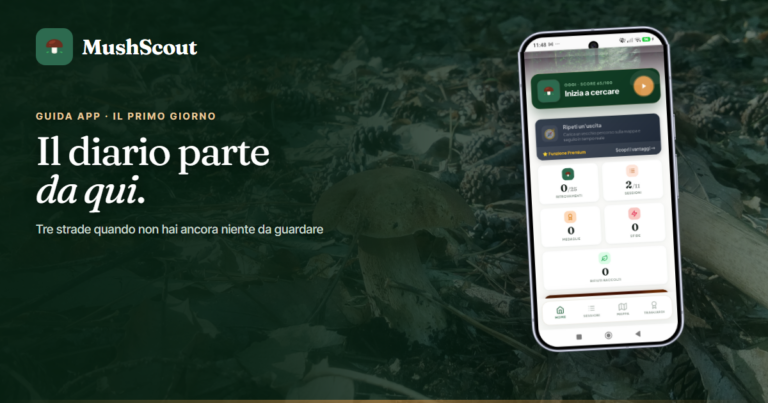
If you have a notebook or specific memories, you can fill the diary from memory: the app finds the weather for those days on its own. E per un bosco dove non sei mai stato c’è l’analisi, che col solo meteo ti dice com’è messo oggi.
If the weatherman got it wrong, you correct it
The forecast starts from weather data, and a weather cell is kilometers wide: in the Apennines within the same cell there are the valley floor and the ridge. If it rained differently for you, you tell him: you choose the day, you indicate how much water actually fell, and what you say beats the model. The score for that place changes immediately.
The weather data comes from Open-Weather, licensed under CC BY 4.0.
Frequently asked questions
What does the forecast number mean?
Quanto la giornata di oggi, in quel bosco, somiglia ai giorni in cui si trova davvero: è la Average dei funghi di stagione. Più è alto, più vale la pena muoversi. Il numero di un fungo preciso lo trovi nella sua scheda.
Does the forecast say where to find mushrooms?
No, and be wary of anyone who promises it. It says when conditions are favorable in the places you found. It's not a guarantee of harvest: it's a way to choose the day.
Why do two of my forests have different numbers on the same day?
Because they have different stories: different altitudes, different rainfall, and you find them in different periods. This is exactly why a provincial bulletin is not enough.
Is the twelve-day calendar free?
Senza pagare vedi Today's score e la forma della settimana su un bosco. Con Premium vedi i dodici giorni su tutti i tuoi boschi, giorno per giorno, il giorno in cui la finestra si apre e cosa manca, e quanto.
From how many exits does it start working?
It works from day one with the scientific part and the weather of the area, and becomes yours as you record. The first outings serve to introduce her to your woods: here we explain how it learns.