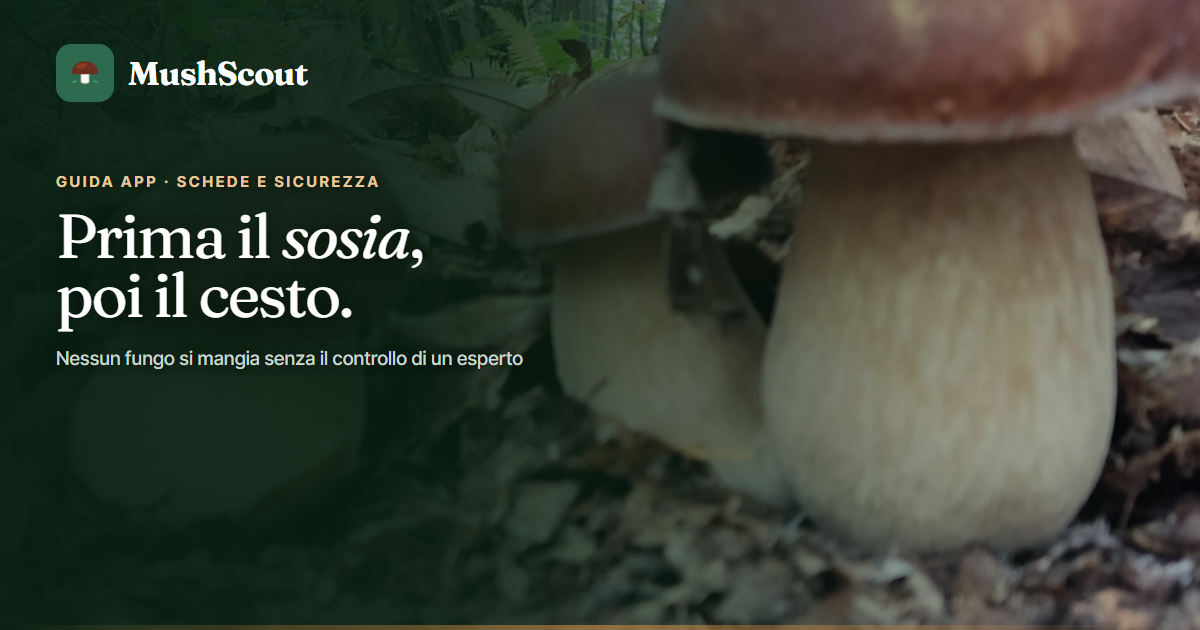
Let's start at the end, because that's the part that counts: no app can tell you if a mushroom is eaten. Neither this nor others. Everything that follows - the cards, the photos, the comparisons with the lookalikes - serves to make you more prepared in front of an expert, not to replace him.
What's in a card
MushScout has seven complete cards: the four porcini mushrooms, the chanterelle, the good ovolo and the drumstick. Each is built to answer questions in the order one asks them in the woods:
- the identikit, for the impression at a glance;
- how to recognize it in detail: cap, flesh, stem, color change, smell;
- where and when it grows, with which trees and at what altitudes;
- how it is distinguished from mushrooms that resemble it;
- the security block, always in sight: the dangerous doubles and what they expose themselves to.
The same cards can also be consulted on the site, without installing anything.
One thing said clearly, because it is right to know: the cards are drafts currently undergoing mycological validation. They are a study aid, not the last word.
The lookalike is the real deal
Those who poison themselves almost never pick a mushroom they had never seen: they picked something that resembled what they were looking for. This is why the block on lookalikes is not at the bottom of the card but inside, next to the recognition.
And for this reason the only character that is valid is the one that separate two species, not what they have in common. “Brown Hat” has never saved anyone.
And the recognition from the photo?
You photograph a mushroom and the app suggests a species. It's useful for orienting yourself and learning names, and this is what it does: proposes.
It is not an identification, for a technical and non-prudential reason: a photo does not contain the information needed to distinguish two close species. It doesn't contain the smell, it doesn't contain the texture of the flesh, it doesn't contain the color change when cut, it doesn't contain what the base of the stem looks like under the ground — which in some cases is the only character that separates an edible mushroom from one that can kill.
So the name you read is a hypothesis to be verified, and should never be used to decide whether a mushroom can be eaten.
In the free plan you have three recognitions per day, plus bonuses; with Premium fifty, which is a brake on abuse and not a limit on use - no one who goes on mushrooms gets there.
The rule that comes first
Before eating any mushroom, have it checked in person by a mycologist or the mycological inspectorate of your local health authority. The service exists throughout Italy, is free in most regions, and takes less time than you think.
Some toxic mushrooms kill, and they do so in a way that makes it unnecessary to notice it late: with the phalloid amanita the symptoms arrive after many hours, when the damage to the liver is already underway. There is no such thing as "taste a piece to try".
Two habits that expert foragers take for granted: keeping species separate in the basket, and not trusting the evidence at home — the garlic that blackens, the silver spoon, the mushroom that "peels." They are legends, and they have sent people to the hospital.
The collection rules are set by your region
Card, maximum daily quantity, days allowed, areas closed or reserved for residents: they change from one region to another and sometimes from one municipality to another. We have collected the picture region by region.
Common sense of the forest also applies: ventilated basket and not bag, mushrooms cleaned on the spot, no raking of the litter.
Frequently asked questions
Does the app recognize mushrooms from the photo?
It offers a name as a suggestion to check, not an identification. It should not be used to decide whether a mushroom is edible: for that you need a mycologist from the ASL.
Are the cards validated by experts?
These are drafts currently undergoing mycological validation. They are used to study and compare, not to give the green light to a mushroom you have in your hand.
How many cards are there?
Seven complete: the four porcini mushrooms, the chanterelle, the good ovolo and the drumstick. The other species followed by the app have seasonal and environmental information.
Where do I check the mushrooms?
To the mycological inspectorate of your ASL. It's public service that does exactly that, and it's the right answer even when you're sure of what you've collected.
How many recognitions can I do per day?
Three in the free plan, plus bonuses; fifty with Premium. The high ceiling only serves to prevent automatic uses of the app.