
When are porcini mushrooms born after the rain? It's the question every seeker asks himself while looking at the sky. The short answer: usually between 7 and 14 days. But that number alone makes you miss the woods.
How many days after the rain the porcini mushrooms are born depends on three things: how much water has fallen, what temperature it is afterwards, and whether it is windy. Rain is the trigger. The rest decides the timing.
The rain starts the count. The temperature decides how long it lasts.
In short
- Abundant rain is needed: below 20-30 mm is often not enough.
- Then you wait 7-14 days.
- Mild heat shortens the time; cold and dry wind lengthen them.
The short answer: 7 to 14 days
After a good watering, the first porcini mushrooms usually appear between 7 and 14 days. In ideal conditions even in a week. In cold, dry or windy conditions, it takes two weeks or more.
The mycelium, the network that lives underground, is reactivated with water. Then it takes a few mild days for it to push out the fruiting bodies, i.e. the mushrooms you collect.
It's not just the rain that matters. It matters how much.
A light rain wets the leaves, not the ground. To trigger births, the water must reach deep into the mycelium. As a reference, rainfall below 20-30 mm is often not enough.
- Little rain (under 20 mm): wets the surface, short effect.
- Abundant rain (30 mm or more): reaches the roots and triggers the mycelium.
- Better several days of constant rain than just one violent storm.
The temperature decides the timing
With water in the soil, it controls the temperature. The ideal air range is between 15 and 25°C. The milder it is, the sooner they come out. If it's too hot or too cold, they freeze.
The ground, not just the air
Soil temperature also matters. Below 6°C, births stop. Above 30°C maximum, ditto. At the beginning of the season the woods leave for the sun first; in summer the fresh ones in the north do better.
The wind, the silent enemy
A dry wind can ruin everything. Scirocco, Favonio and Tramontana dry out the newly wetted soil. After the rain, mild days and without strong winds are needed.
Because in your forest the days are different
Here's the point that generic tables ignore. The “after X days” applies on average. But your mushroom farm has its own quota, its own exposure and its own land. The same rain, at 400 and 1200 meters, gives different times.
- Share: the higher you go, the longer the times get and the season slips.
- Exposure: in the south first at the beginning of the season, in the north better in summer.
- Land: a soil that retains water lengthens the good window.
This is why a valid number for everyone does not exist. Your seat number applies.
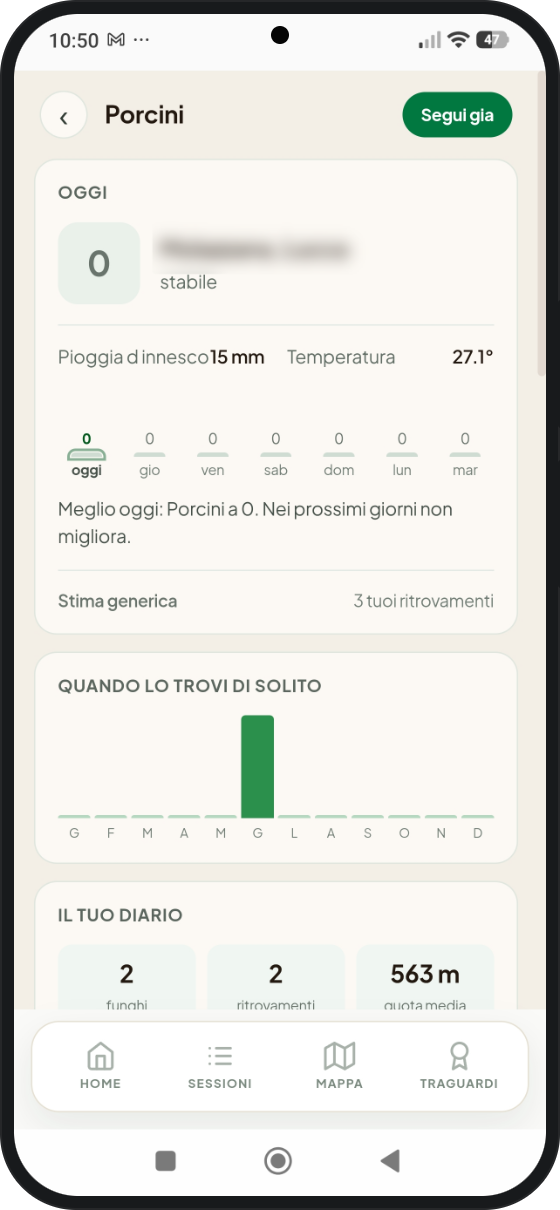 Trigger rainAutomatic counting
 Rainy days29 mm, 10 days ago
Because I look at the weather like this
For years I counted the days on the kitchen calendar. I marked the rain with a cross and went back after ten days. I was often wrong: the right rain in the valley was not the right one at high altitude.
I also did MushScout to stop guessing in my head, and leave the counting to those who aren't distracted.
— Federico, Mush Scout
Stop counting days by hand
MushScout does that math for you, for your area. It combines three things: basic scientific knowledge, anonymized data aggregated within a 50 km radius around you, and your personal diary. See how much useful rain has fallen, how many days have passed and what temperature has followed. And it gives you a number, not a feeling.
The coordinates of your places remain secret: the algorithm works on large areas, never on a single collection point. And the more searchers use it in your area, the more accurate the local forecast becomes — for everyone. Download it on Google Play.